
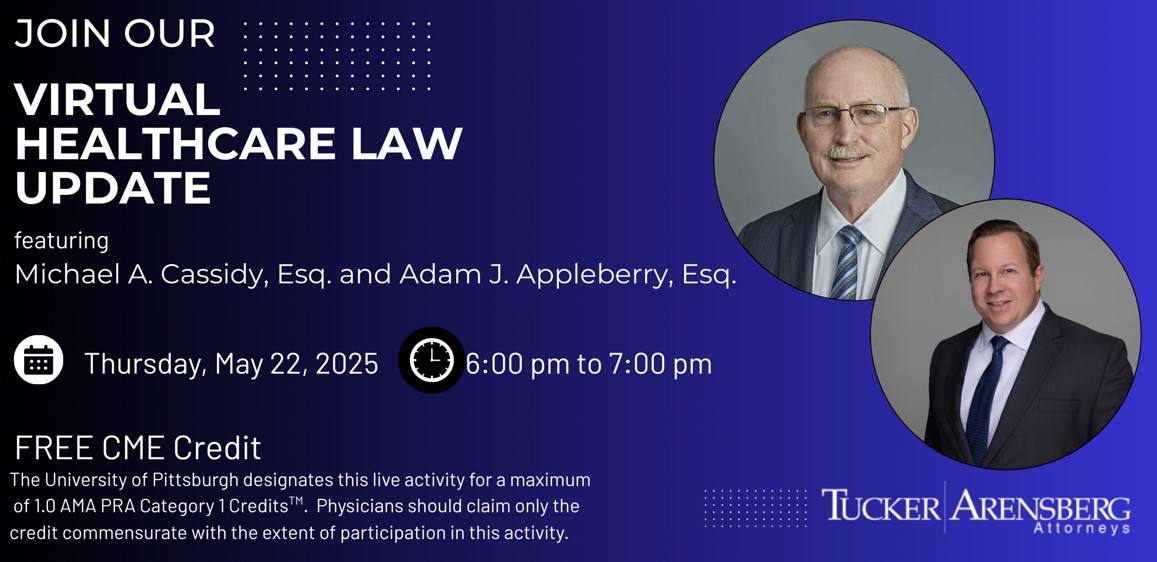
On Thursday, May 22, from 6:00 – 7:00 PM, attorneys Michael Cassidy and Adam Appleberry will present a virtual program focused on the legal framework surrounding restrictive covenants in healthcare employment contracts.

The presentation will cover recent developments in the law, including the Fair Contracting for Health Care Practitioners Act, and other regulatory changes that

INTRODUCTION

When physicians have finally completed the medical education journey, many are confronted with a “physician employment contract,” usually from a hospital or medical practice, which could define the essential terms of their professional relationship for many years to come.  If the parties live happily ever after, neither may ever read the contract again.  However,

INTRODUCTION

When physicians have finally completed the medical education journey, many are confronted with a “physician employment contract,” usually from a hospital or medical practice, which could define the essential terms of their professional relationship for many years to come.  If the parties live happily ever after, neither may ever read the contract again.  However,

In CMS Advisory Opinion AO-2011-01, CMS has issued a favorable advisory opinion allowing the physician recruitment arrangement with a hospital and a physician practice which imposes a restrictive covenant upon the recruited physician.

Restrictive covenants and recruitment arrangements had initially been prohibited by the Stark Rules. However, bowing to industry comment, CMS amended the physician

Several physicians employed by Court Street Family Practice, a division of the Sisters of Charity Health Systems Inc. (Health System) resigned to join a competing practice owned by a competing health system. The employment contracts included a “Limitation of Practice” clause which “forbade them from practicing medicine with Central Maine Health Care Corporation, its affiliates or


INTRODUCTION

When physicians have finally completed the medical education journey, many are confronted with a “physician employment contract,” usually from a hospital or medical practice, which could define the essential terms of their professional relationship for many years to come. If the parties live happily ever after, neither may ever read the contract again. However, if

There have been many articles written about the negotiation and enforceability of physician restrictive covenants, but there are just a few fundamental concepts crucial to understanding and successfully navigating these issues.

1.         The Myth of Unenforceability. Many physicians either completely ignore or dismiss the significance of restrictive covenants because of the mistaken belief that restrictive covenants are unenforceable. Except in those states which statutorily ban restrictive covenants, such as California and Kentucky, this is simply not true.

2.         Suspect Enforceability. It is true the courts in many states look with disfavor upon restrictive covenants; courts often search for exceptions and methods to invalidate restrictive covenants, because of the significant impact upon the individuals involved. However, this attitude does not make restrictive covenants unenforceable. It simply means that courts respond favorably to the arguments of making sure that the restrictive covenants are reasonable both in time and scope. However, that is certainly no reason for any individual to believe that a court will find a way to minimize the potential harm or impact of a restrictive covenant. 

3.         Injunctions and Liquidated Damages. Restrictive covenants are often enforced through injunctions, which are court orders specifically prohibiting a physician from violating the terms of a restrictive covenant, i.e. preventing practice within the time and area described by the contract. Injunctions in these matters are issued routinely. Some contracts include liquidated damages provisions, which gives the practice the option of seeking money damages instead of an injunction. If the liquidated damages are fairly low, that might actually be a benefit to the physician, who can argue that the parties have already agreed upon the damages so that an injunction is not necessary. Although the presence of a liquidated damages clause in a restrictive covenant might benefit the physician, it would be a gamble to rely upon that argument.

4.         Unenforceability and Breach. The restrictive covenant is part of a contract between the practice and the physician. If the practice breaches its agreement, it is logical and reasonable for the physician to believe that he would not be bound by a contract and a restrictive covenant that have been breached by the practice. That is a legitimate and a reasonable outcome, but it necessarily depends on proving the antecedent breach.

5.         Negotiation of Options. The harm and impact of the restrictive covenant is twofold, not only does it prohibit certain practice activities, but it provides the practice overwhelming leverage in future negotiations. Your initial negotiation strategy should always include an attempt to limit the scope of the restrictive covenant so that the physician will later have some reasonable practice alternatives that limit the leverage in this situation. Continue Reading Physician Restrictive Covenants

PHYSICIAN CONTRACTS & ISSUES

INTRODUCTION

The structure, purpose and terms of every physician contract are different. The content and style vary with the institutional or private practice nature of the employer and the needs and leverage of the physician.  Following is a list identifying major issues or components.

I.          COMPENSATION

1.         Base Compensation.

A.         Fair market value